
Monroe County Release Date Meanings
“Projected release date” is a useful search phrase, but Michigan records use more exact terms. A date can mark the first day the Parole Board gains jurisdiction, the maximum boundary of a sentence, a date when parole actually began, or the day a Monroe County jail booking ended. Those events are not interchangeable.
A pretrial detainee usually has no computed sentence-release date. The next custody change depends on bond, a court order, dismissal, plea, sentence, or another agency’s hold. For a county jail sentence, the commitment, jail credit, and Sheriff record are the proper sources. For a state sentence, OTIS and MDOC supply the public date trail.
A transfer also changes the meaning. The Monroe Sheriff can close a county booking when custody passes to MDOC, ICE, USMS, Border Patrol, or another county. That release date confirms the Monroe booking ended, not that the person entered the community.
Lookup Monroe County Projected Release Dates
Begin with the system that owns the custody record. The Monroe Sheriff Zuercher portal has an actual Release Date filter for ended jail bookings, but it does not publish a projected field. The MDOC Offender Tracking Information System is the state-prison route.
- Decide whether the person is in the Monroe County jail, an MDOC prison, or another system. Do not use OTIS for a jail-only stay.
- For MDOC custody, search OTIS by MDOC number when possible. A name search requires careful comparison of aliases and descriptors.
- Read status and location before the dates. “Prisoner,” “Parole,” “Probation,” and “Discharged” describe different stages.
- Open each sentence entry. Record the exact labels, including Parole Board Jurisdiction Date, Maximum Date, or Date Paroled.
- For a future county-jail date, ask the sentencing court and Sheriff records staff about the commitment, jail credit, release order, and other holds.
- When the date arrives, confirm the event through OTIS status, the Monroe Release Date result, or an agency record.
The official OTIS search screen shown below accepts the name or number used to locate a state corrections profile.
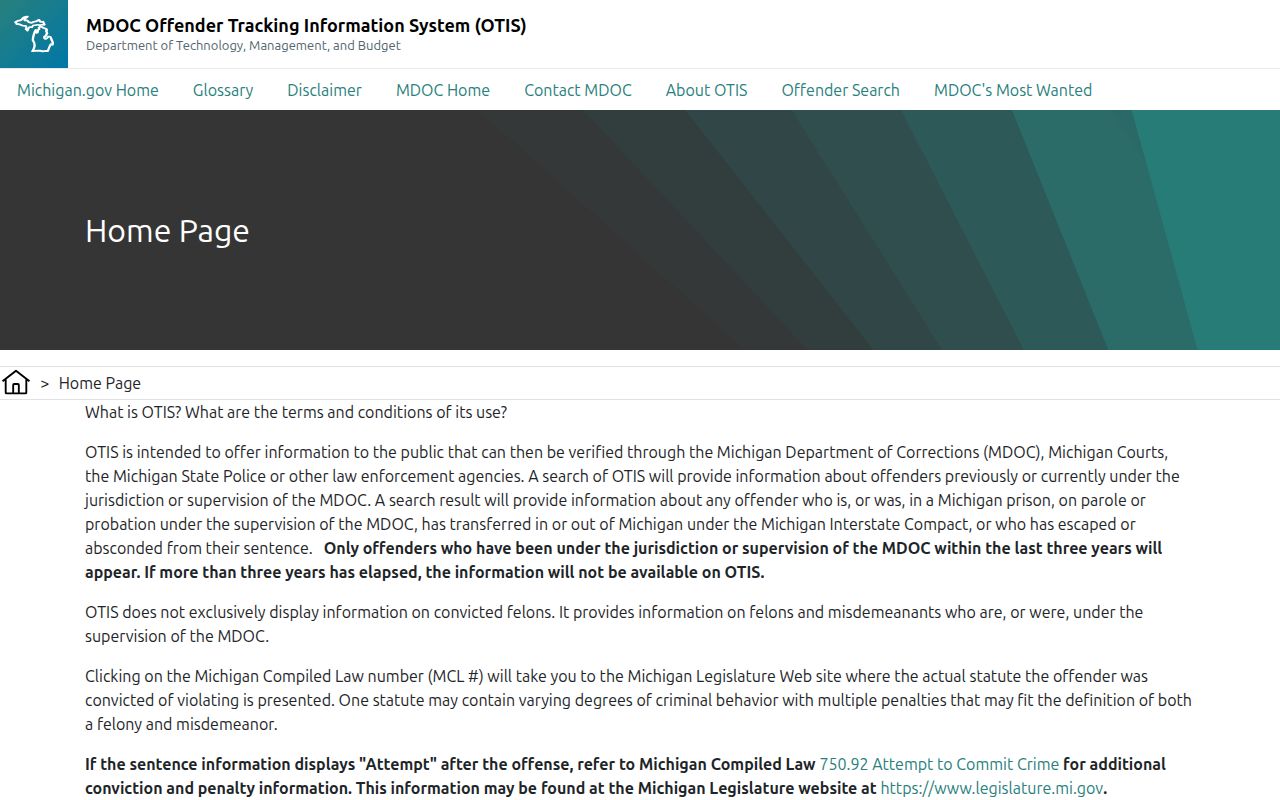
The search result is only the entry point. The profile’s status, sentence entries, and labeled date fields determine what can safely be said.
Read Monroe County OTIS Dates
OTIS does not offer one universal promise called a projected release date. Its current term nearest to an eligibility date is “Parole Board Jurisdiction Date.” MDOC also explains that field as the earliest release date in applicable cases, but the careful meaning is the first point when Board jurisdiction may begin. The Board can still deny or defer release.
| OTIS label | What it safely means | What it does not prove |
|---|---|---|
| Parole Board Jurisdiction Date | Earliest point Board jurisdiction or eligibility may begin | That release will occur that day |
| Maximum Date | Potential end boundary shown for the controlling sentence | A guaranteed exit without checking other terms or holds |
| Date Paroled | Date the person left prison on parole | That the full sentence and MDOC control ended |
| Status: Parole | Physical release with continuing parole authority | Final discharge from MDOC |
| Status: Discharged | MDOC jurisdiction ended for the displayed matter | A single physical outcome, because MDOC says the label can include death |
Open every sentence. Consecutive terms can be combined, while another active sentence can keep custody in place. OTIS may not reflect every court change at once, so compare a disputed date with the judgment and later orders. Discharged records also leave public OTIS three years after discharge, making an older no-result inconclusive.
Michigan Minimum Terms in Monroe County
Michigan Truth in Sentencing is not an 85% rule. For covered modern offenses, the prisoner must serve the full minimum term imposed by the judge in a secure facility before parole eligibility. Good time and disciplinary credits do not cut that judicial minimum. Nor does serving the minimum require the Board to grant release.
The transition matters. Official MDOC material applies the modern structure to listed assaultive offenses committed on or after December 15, 1998, and to other offenses committed on or after December 15, 2000. Older crimes and special sentencing laws can follow different credit rules. Offense date must be checked before any calculation.
MCL 791.234 addresses parole jurisdiction and distinguishes older credit-eligible sentences from modern disciplinary-time terms. MCL 800.33 governs legacy good time and disciplinary credits for qualifying older offenses. MCL 800.34 describes disciplinary time for modern covered offenses. These laws explain why two Monroe County prisoners with similar sentence lengths can have different date calculations.
Note: Full service of the minimum opens the parole decision stage for a covered sentence; it is not an automatic release command.
Why Monroe County Release Dates Change
A date can move because the legal record, sentence structure, conduct record, release decision, or custody destination changes. Each cause belongs to a different source. The court controls sentence corrections and jail credit. MDOC calculates state terms. The Parole Board controls a discretionary parole decision. Another agency controls its own detainer.
| Change | Effect on the date | Best confirmation |
|---|---|---|
| Corrected sentence or jail credit | Recalculates the controlling term | Judgment, amended order, and MDOC calculation |
| Consecutive sentences | Terms must be aggregated | All sentence entries and court orders |
| Legacy credits | Credits may be earned, lost, or restored | MDOC record under the applicable older law |
| Misconduct | Can affect disciplinary time or suspend favorable action | MDOC and Board action records |
| Board decision | Grant, denial, or deferral changes the expected path | Notice of Action and later OTIS status |
| Detainer or other sentence | Can prevent community release after one date arrives | Held-for agency and receiving custodian |
| Life sentence rules | Special review gates or clemency may apply | Statute, Board record, and court sentence |
A favorable Board action can also be suspended before release when misconduct or adverse information appears. Placement or treatment planning may cause a deferral. The projected date should therefore be treated as a changing legal and administrative marker until the custody record confirms the exit.
Monroe County Jail Date Calculations
Do not copy an OTIS state-prison field onto a Monroe jail-only sentence. County jail release depends on the court’s stated term, valid jail credit, bond or release orders, and any other hold. The public Monroe portal exposes the actual date an ended booking was released, not a future calculation.
For a future date, ask the sentencing court for the commitment or judgment and ask the Monroe County Sheriff’s Records Division whether the booking has another held-for agency. The Sheriff records office is at 100 E. Second Street, Monroe, and can be reached at 734-240-7415. A request for a precise event can identify the booking, expected sentence calculation, and any release timestamp that later exists.
A bond order is not the same as a completed release. Payment or surety may still need processing, and another case can keep the person held. A sentence of time served can explain an exit, but it does not defeat a detainer. The Monroe County release record and search path helps trace the actual county event after the projected date.
Monroe County Parole Timing
The Michigan Parole Board considers the offense, prior record, prison conduct, programs, age, guidelines, risk material, interview, and victim or other submissions. Parole Board Jurisdiction Date only marks when that process may reach the decision stage. Eligibility does not dictate the outcome.
Possible results include a grant, denial, deferral while a plan or program develops, suspension of favorable action, and later revocation after release. An individual result appears in a Notice of Action or Decision. Michigan’s public hearing page is event driven and does not list every routine review, so absence there does not mean that no review took place.
Once physical release occurs, OTIS may show Date Paroled and a Parole status. That is release from prison with continuing MDOC supervision, not discharge. The Monroe County post-release supervision process explains how to verify that next stage through OTIS and the Region 9 office.
Confirm Monroe County Actual Release
Use a status event, not the calendar alone. For a state prisoner, compare OTIS status and Date Paroled with the sentence and any Notice of Action available to the entitled party. For a county detainee, search the Monroe portal by Release Date and obtain the Sheriff booking and release record when the meaning or timestamp matters.
MI-VINE can send notice of a participating custodian’s release or transfer event, yet it is not a certified archive and may stop returning a person after release. A VINE no-result does not prove release. The jail, MDOC, court, or receiving agency supplies stronger confirmation.
Finally, read the destination. A Monroe booking can end in a transfer to MDOC, ICE, USMS, Border Patrol, another county, or another authorized custodian. Only after that check can the event be described accurately as a community release, parole, discharge, or continuing custody elsewhere.
Resolve Monroe County Date Conflicts
Public systems can disagree for ordinary reasons. OTIS warns that court actions may not appear at once. The Monroe portal publishes an actual release date but no public timestamp, update cadence, or archive limit. A court entry can authorize release without recording the Sheriff’s door-out time. Keep each source attached to the event it owns.
For a county booking, request the existing booking and release record from Sheriff Records. Identify the person, date of birth or booking number, approximate booking date, release date and time, disposition or reason, held-for agency, and receiving agency if the event was a transfer. A focused request is easier to search than a demand for all release data.
For an older state discharge, sentence calculation, release record, or Board document not exposed in OTIS, use MDOC FOIA. Include the MDOC number, full name, date range, and exact existing records sought. A formal request can recover records after the three-year public OTIS display ends, subject to lawful exemptions and retention.
The Monroe court record should be obtained from the court, not through County FOIA, because Michigan FOIA excludes the judiciary from its public-body definition. District Court can explain a misdemeanor, bond, or preliminary felony event. Circuit Court is the main source for a felony judgment and sentence. The agency release record then confirms when the physical custody stage actually changed.