
Monroe County Booking Photo Records
A booking photograph documents appearance during an intake event. Monroe County Sheriff materials describe photographing people during intake, which supports the existence of intake imagery as a record category. Release does not transform that image into a current-custody record. It remains tied to the old booking and must be read with the booking number, arrest date, release date, and case disposition.
Michigan law does not promise that every Sheriff booking photograph will be published online. A photograph held by a public body can qualify as a public record, but disclosure still depends on the Michigan Freedom of Information Act, applicable exemptions, redaction, retention, and the actual record held. A public interface can show less than the agency file contains.
The responsible question is which agency created the image. A Monroe Sheriff intake photo differs from an MDOC identification photo made after a state-prison commitment. A news image may have come from either agency or another event. Keep the source and date attached to any copy so the picture is not made to claim more than the underlying record.
Find Monroe County Released Mugshots
Several channels can surface an image, but their coverage and authority differ. Monroe’s configured Zuercher results currently omit a mugshot column. Sheriff Records is therefore the direct county fallback. OTIS serves state corrections cases, while VINE may show an image only when the participating custodian supplies one.
| Channel | Photo availability | How to use it |
|---|---|---|
| Monroe Sheriff portal | Not in the current configured result columns | Use Release Date to identify the booking, then request the image |
| Sheriff Records/FOIA | An existing intake photo may be produced | Submit a narrow person-and-booking request; production is not guaranteed |
| MDOC OTIS | Electronic offender image may appear | Use for a person who entered MDOC, not a jail-only stay |
| MI-VINE | May display a custodian-supplied image | Use as a custody and notification service, not a photo archive |
| Official news release | May carry an agency-supplied image | Check event date, source agency, and later case status |
| Commercial or third-party publication | May retain a stale or mislabeled copy | Do not use it to confirm identity, custody, release, or disposition |
There is no verified official Michigan Monroe County Sheriff jail-information app that adds a mugshot channel. VINELink has mobile access, but it is not a Sheriff photo gallery. An app with a similar county sheriff name can belong to another state, so publisher and jurisdiction must be confirmed before the app is attributed to Monroe County, Michigan.
Monroe County Mugshot Portal Limits
The Sheriff-linked Zuercher inmate portal has filters for name, in-custody date, arrest date, and release date. Its configured result columns are name, race, sex, age or date-of-birth presentation, arrest date, held-for agency, and release date. Hold reasons are enabled.
The generic portal template can support a photo position, but Monroe’s current `available_columns` setting does not include mugshot. That technical distinction prevents a false promise. A Release Date search may identify the ended booking without displaying its image. The absence of a photo on that result does not prove that no intake photograph was made.
The portal also lacks a published update cadence or archive-retention promise. Capture the booking context while it is visible. When the result has aged out, is ambiguous, or must be documented, the Records Division can search the agency’s retained files under its rules. The Monroe County 24-Hour Releases method can help identify the recent booking date before a photo request is filed.
Request Monroe County Booking Photos
Ask the Sheriff’s Records Division for the existing intake or booking photograph together with enough booking data to identify it. A narrow request is easier to search and review than a demand for all photographs from a broad period. Include the full booked name, date of birth if known, approximate booking date, and booking number when available.
- Confirm the person and booking through the Sheriff portal, court case, or known booking information.
- Download the Monroe County FOIA request form.
- Ask for the existing intake or booking photograph and booking/release record for the named person and date.
- Request electronic delivery and invite redaction of exempt material rather than denial of the whole record.
- Send the completed Sheriff request to foia_sheriff@monroemi.org and retain proof of submission.
- Review the response for the correct booking number and image source before treating the photograph as a match.
The official Sheriff Records Division page shown below provides the county contact and FOIA route.
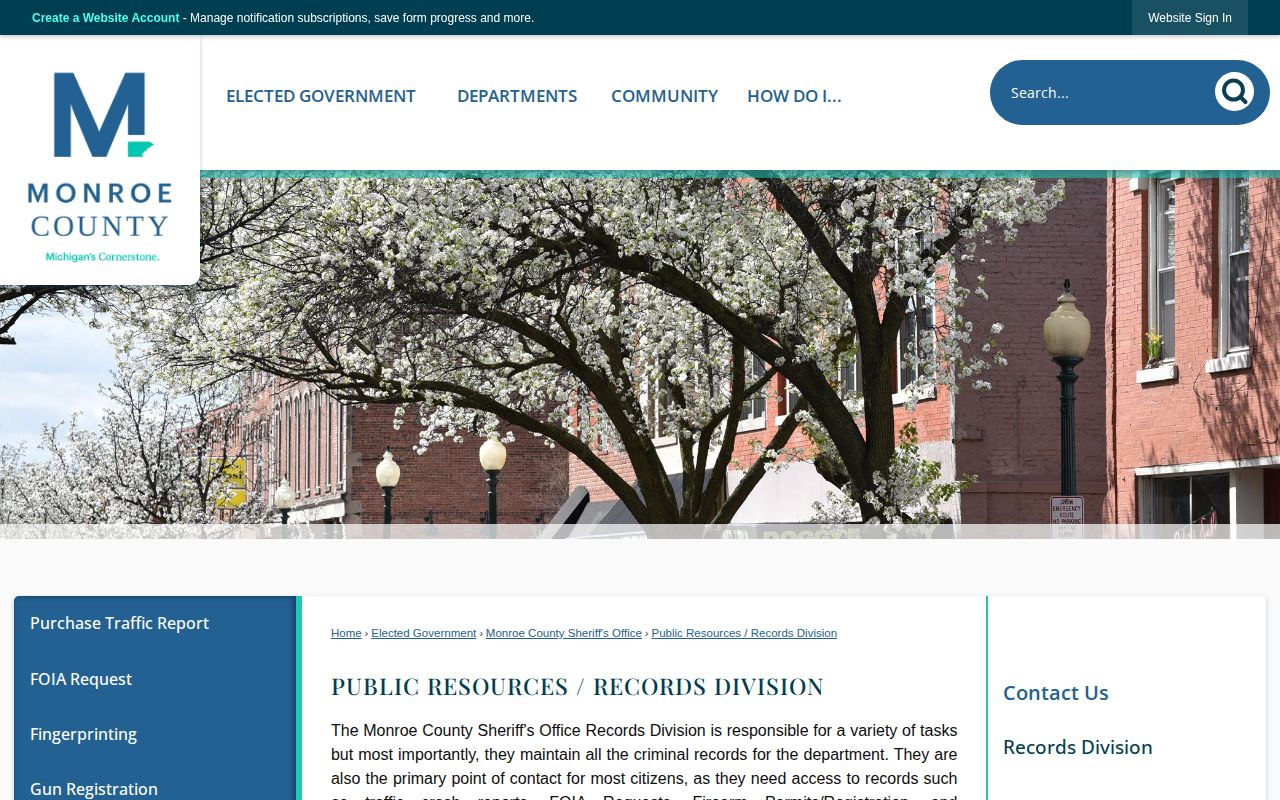
That office is the best direct fallback when the public roster identifies a release but does not render the booking image.
Monroe County Photo Request Rules
The Sheriff Records Division is at 100 E. Second Street, Monroe, MI 48161. Its telephone is 734-240-7415, and the county states that it operates 24 hours a day, seven days a week. General records email is sheriffrecordsmail@monroemi.org. Those contact facts do not guarantee immediate image production.
Michigan FOIA is MCL 15.231 through 15.246. The county process follows a five-business-day response structure: grant, deny, partial grant, no responsive record, or a single extension of up to ten additional business days. A response date may not be the production date if a deposit, extensive search, or lawful clarification is needed.
Allowable fees can include search, examination, separation, duplication, media, and postage within statutory limits. Labor generally uses the lowest-paid capable employee and fifteen-minute increments. The research does not establish a fixed booking-photo price, so none should be assumed. Disclosure can also be limited by privacy, active-investigation, security, or other lawful exemptions. Asking for segregable nonexempt material allows the agency to redact a protected part while considering the rest.
Monroe County MDOC Photo Differences
MDOC OTIS may display an electronic offender image for a person who entered state corrections. It is an MDOC image, not necessarily the photograph taken by the Monroe County Sheriff. Use the MDOC number when known and compare aliases, physical descriptors, sentence entries, and status before deciding that a candidate profile is the same person.
An OTIS image can be absent. MDOC explains that some people left custody before electronic photographs were used or did not have an electronic photograph taken. Missing imagery does not negate the offender record. For an existing state image that is not public, a focused request may be sent through the MDOC FOIA channel, though production remains subject to law.
OTIS also removes discharged offenders from public display three years after discharge. A later no-result cannot disprove an older state sentence or image. MDOC FOIA, the court record, and the Sheriff record each cover different parts of the history; none should be presented as a substitute for another agency’s photograph.
Monroe County Mugshots Beyond OTIS
MI-VINE may display a person image when the participating jail or prison provides it. Its main purpose is custody search and notice of release or transfer, not preservation of old booking photos. A person may stop appearing after release, so a VINE no-result says little about whether an image once existed.
A reputable local agency or news release may reproduce an agency-supplied photograph. Read the release date and event carefully. An arrest image does not prove conviction, present custody, or final case outcome. The underlying Sheriff, police, court, or MDOC source should control any description.
Commercial arrest-photo pages and other third-party copies can be stale, mislabeled, or detached from the later disposition. No such service is linked or endorsed here. Never use an unofficial copy to work around an official removal, a sealed record, or a set-aside. The proper response to an uncertain image is to return to the originating agency and case record.
Monroe County Mugshot Access Changes
Michigan set-aside law is chiefly found in MCL 780.621 and the sections that follow. A set-aside changes public access to court and criminal-history information. OTIS says set-aside or expunged convictions are removed from public results. That later absence does not rewrite the fact that an intake event occurred, but it does limit what should be sought or repeated publicly.
No current Michigan statute specifically regulating mugshot publication or charging to remove mugshots was verified in the official compiled laws. Another state’s rule must not be borrowed. Michigan FOIA, exemptions, segregation and redaction, retention, and set-aside rules form the documented framework for Monroe County photo access.
Use Michigan’s official Clean Slate information for general set-aside pathways. Individual eligibility calls for case-specific legal help. If an official source still displays information affected by a lawful order, contact that source with the order and exact record location rather than paying a commercial removal service.
Verify Monroe County Photo Identity
A photograph alone is weak identification. Compare the full booked name, middle name, age or date of birth, booking or MDOC number, arrest date, agency, and case number. A common name or visual resemblance is not enough. The image should remain tied to the record that explains when and why it was made.
Then check status. The Sheriff’s release date shows that a Monroe booking ended, while the court can explain bond, sentence, dismissal, or another order. OTIS can establish a later state commitment, parole, or discharge. A held-for entry for MDOC, ICE, USMS, Border Patrol, or another county can mean the Sheriff transferred custody instead of releasing the person to the community.
If two official sources show different images, do not assume one is false. They may depict different intake events or an MDOC photograph taken later. Record each source and date. When a match remains uncertain, ask the originating agency to confirm its own record rather than relying on an unofficial repost.