
Monroe State Prison Release Path
A felony sentence from Monroe County can send a person from the county jail to an MDOC institution elsewhere in Michigan. The Sheriff then records an end to the Monroe booking, but that event is a transfer out of county custody. It is not a community release. The 38th Circuit Court record explains the sentence, and the Michigan Department of Corrections becomes the responsible custodian.
MDOC's Offender Tracking Information System, called OTIS, is the main public trail. It covers people under MDOC jurisdiction, not every Monroe County arrest or jail-only sentence. A person who never entered state corrections may be absent. Once MDOC is involved, the profile can show prisoner, parole, probation, or discharged status with sentence and supervision details. Each term marks a different stage.
| System | Custody event | What it proves |
|---|---|---|
| Monroe Zuercher | County booking release or transfer | The Sheriff booking ended |
| 38th Circuit Court | State prison commitment | Legal sentence and jail credit |
| OTIS | Prison, parole, probation, discharge | Public MDOC status and state dates |
| MDOC FOIA | Older or fuller state record | Existing agency records subject to law |
Search Michigan Prison Release Records
Open MDOC OTIS and use an MDOC number when possible. It is the strongest identifier. A name search can be narrowed with descriptors, then checked against aliases and sentence entries. Read the current status before interpreting dates. A candidate list alone cannot show whether the selected person is the Monroe County defendant in question.
- Search the MDOC number or the legal name and available descriptors.
- Open the matching profile and compare identifiers, aliases, and offense history.
- Read status and location or supervision information before looking at dates.
- Open each sentence entry and distinguish eligibility from actual parole or discharge.
- Compare the state record with the Monroe County Circuit Court sentence.
- Use MDOC FOIA when the profile has aged out or a complete existing record is needed.
The official OTIS search screen below shows the state name and number search used for a Monroe County prison case.
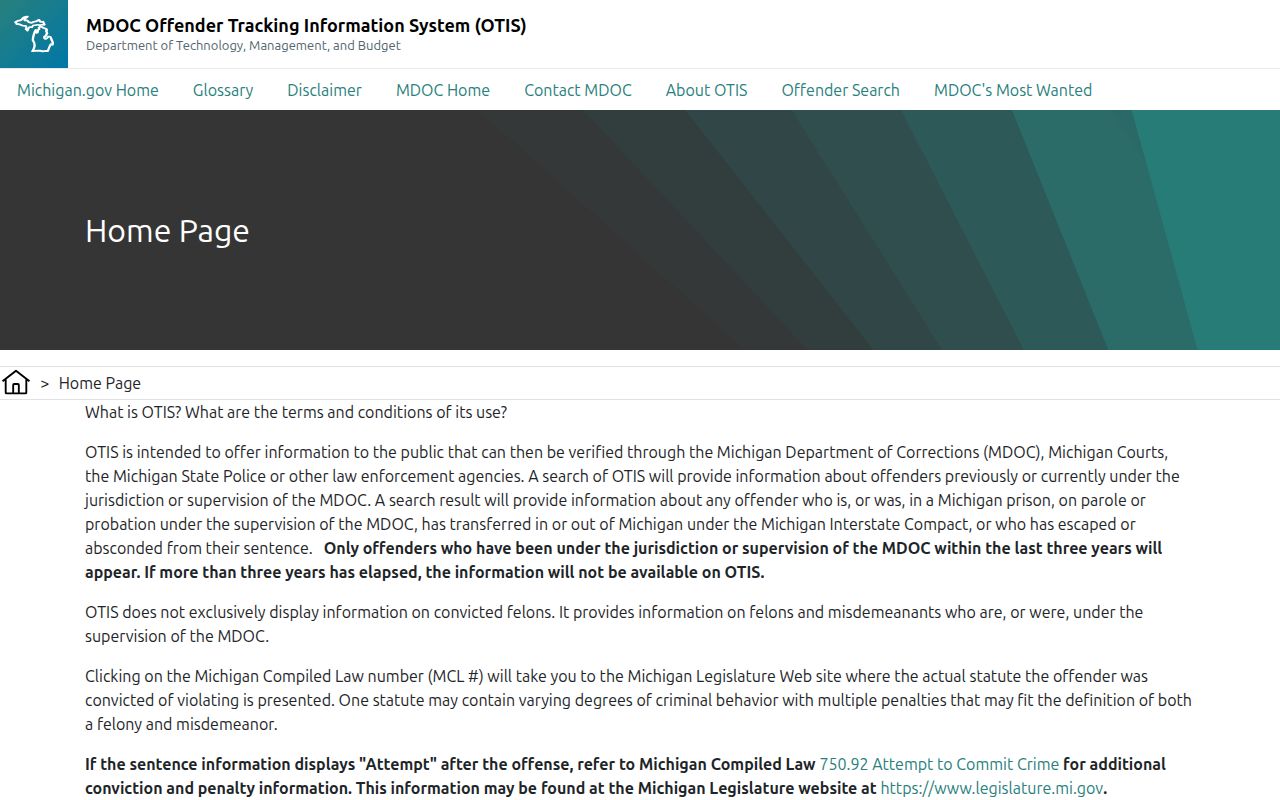
This state interface follows MDOC jurisdiction. It should not be described as the Monroe County Jail release list.
Read Michigan Release Status
OTIS separates current status from date fields. Prisoner means current state incarceration. Parole means the person has physically left prison but remains under MDOC authority and conditions. Probation is community supervision imposed through a sentence and is not the same as parole. Discharged generally means the displayed MDOC relationship ended, although MDOC notes that the status can include completion, maximum discharge, or death. Do not turn it into a claim about a living person's physical exit without checking the related dates.
The Parole Board Jurisdiction Date is the earliest point at which Board jurisdiction or eligibility may begin in the relevant case. It is not an appointment for release. Maximum Date is a potential end boundary that still must be read with all sentences and holds. Date Paroled identifies the actual date the person left prison on parole. A future date becomes reliable release proof only after the state status and event record show that release occurred.
- Parole
- Release from prison to MDOC community supervision.
- Probation
- Court-ordered community supervision that may exist without a prison term.
- Discharge
- The end of the displayed MDOC sentence or supervision relationship.
- Detainer
- Another authority's hold that can block community release or require transfer.
Important: An eligibility or maximum date is not proof that a Michigan prisoner was released on that date.
Michigan Prison Release Calculations
Michigan Truth in Sentencing is not an 85-percent rule. For covered modern offenses, a prisoner must serve the full judicially imposed minimum in a secure facility before becoming eligible for parole. The transition applies to specified assaultive offenses committed on or after December 15, 1998, and other covered offenses committed on or after December 15, 2000. Good-time or disciplinary credits do not shorten that judicial minimum.
MCL 791.234 governs key parole-jurisdiction timing and distinguishes older credit-eligible sentences from modern disciplinary-time cases. MCL 800.33 concerns legacy good time and disciplinary credits for qualifying offenses. MCL 800.34 addresses disciplinary time and the transition. Offense date matters, so two people shown in the same present-day search may operate under different rules.
Even after the minimum, release is not automatic. The Parole Board can deny or defer action. Misconduct can affect disciplinary time or suspend a favorable action. Consecutive sentences must be combined correctly. A court correction, another sentence, or a detainer can also change the path. The safe description is eligibility, not a promised exit.
Monroe Prison Parole Evidence
The Michigan Parole Board is the state's paroling authority for MDOC felony prisoners. Most decisions use three-member panels, while lifer decisions require a majority of the full Board. The Board considers the offense, institutional conduct, programming, history, risk information, interview, and other permitted material. Eligibility does not compel a positive decision, and a positive action still does not prove that the person has physically left prison.
Michigan's public-hearing hub is event-driven. It mainly publishes individual notices for matters such as statutory lifer or clemency hearings, often shortly before the event. It is not a calendar of every routine parole review. No official named-person public decision-results search was verified. An individual Notice of Action or Decision may require the entitled-party, Board, or MDOC FOIA route, while OTIS may later show Date Paroled and Parole status.
For a Monroe County person shown on parole, confirm the OTIS status first. Then use the MDOC field-office directory or Region 9 Monroe office for supervision accuracy. An office assignment shows the responsible agency path; it must not be treated as the person's residence.
Request Michigan Prison Release Records
OTIS keeps discharged offenders in public display for three years after discharge. An older discharged record may therefore disappear even though MDOC still maintains agency records. That creates a predictable false negative. A no-result also occurs when the person only served a county jail sentence and never entered MDOC jurisdiction. Use the source that matches the custody type.
For an older discharge, parole decision document, release record, or existing MDOC image, send a focused request to the MDOC FOIA Coordinator. Include the full name, MDOC number, date range, and specific existing records sought. Michigan FOIA permits redaction and withholding under applicable exemptions, so a request cannot promise production or a photo.
MDOC FOIA Coordinator
P.O. Box 30003
Lansing, MI 48909
517-335-4194
Fax: 517-335-4193
MDOC-FOIA@michigan.gov
For current public search help, MDOC Public Information can be reached at 517-335-1426 or CorrectionsInfo@michigan.gov. Those contacts support the state trail, while Monroe Sheriff Records only controls the county-created part of the earlier transfer.
No Monroe County State Prison
The official MDOC prison directory did not identify a state prison physically located in Monroe County. This facility page represents the statewide institutions that can receive a person sentenced from Monroe County. It must not be read as a claim that a building named Monroe State Prison exists.
The local custody trail starts at the Main Jail or Dormitory. The Sheriff's lookup page leads to the county release portal, which may show the date the county booking ended and a held-for agency that points to MDOC. Secure movement to court over the Main Jail catwalk is not release. Nor is transport from the county jail to a state reception or prison site. The first proves only movement for proceedings; the second begins state custody.
Once a person is paroled, MDOC Region 9 provides the local supervision layer. The Monroe County parole and probation office is at 29 Washington Street and can help verify an office assignment after OTIS. The assignment is not a private home address and must not be represented as one.
Federal Holds Are Separate
Monroe's adult jail held-for list includes MDOC alongside ICE, U.S. Border Patrol, and USMS. Those labels do not point to the same database. MDOC belongs in OTIS. A sentenced federal prisoner belongs in the BOP locator. An ICE detainee belongs in the immigration-custody path. A USMS pretrial case may require the federal court docket and known holding facility.
This distinction prevents a county release date from being overread. A transfer to MDOC starts state custody; a federal handoff starts a different authority's custody. Neither is proof of a return to the community. The Monroe County release search gives the county, state, federal, and immigration fallback routes without combining their meanings.
Note: OTIS is strong evidence for an MDOC status, but it cannot establish the result of an ordinary jail-only or federal custody event.