
Monroe Main Jail Release Paths
The Main Jail is Monroe County's secure adult jail and new-arrest facility. The Monroe County Sheriff's Office Corrections Division operates it beside the county courts complex. When a booking closes, the person may post bond, finish a jail term, receive a court-ordered release, move to another county, or transfer to the Michigan Department of Corrections. Federal holds add more outcomes. A county release event proves that the Monroe booking ended, but it does not always prove that all custody ended.
A community release and a custodial handoff can look similar at first. The decisive details are the Release Date, the held-for agency, the court order, and any receiving authority. A bond exit returns the person to the community while the case stays open. A prison sentence sends the person into MDOC custody. An ICE, U.S. Marshals Service, or other agency hold may produce a transfer. The full Monroe County released-inmate workflow on the home page explains how those records fit together.
| County event | What follows | Best next record |
|---|---|---|
| Bond or court release | Community, unless another hold applies | District or Circuit Court case |
| County sentence completed | Community or supervision | Sheriff release record and court sentence |
| MDOC transfer | State corrections custody | OTIS offender profile |
| Federal or immigration handoff | Continuing custody may apply | BOP, ICE, USMS, or federal court source |
Search Monroe Main Jail Releases
The Sheriff's Inmate Lookup page identifies the official Zuercher portal as Monroe County's public inmate system. Unlike a roster that only lists people still held, this portal enables a Release Date filter. It also presents name, age, arrest date, held-for agency, hold reasons, and release date in its configured results. That makes it the first public source for an ended Main Jail booking.
Use several identifiers. A name-only match can point to the wrong person, especially when names repeat. Age, arrest date, agency, and case context make the match stronger. The portal publishes no fixed update schedule and no promised archive period. An absent record is therefore inconclusive. Older, incomplete, or formal requests belong with Sheriff Records.
- Open the official Zuercher inmate portal from the Sheriff's page.
- Search the full booked name and compare age and arrest details.
- If the person is no longer on a current view, run the known calendar date through Release Date.
- Read the held-for agency and hold reason before calling the event a community release.
- Compare the county result with the correct Monroe court case or receiving-agency record.
- Request the booking and release record when the web result is missing or needs formal proof.
The official Monroe County portal image below shows the filter screen used for county release research.
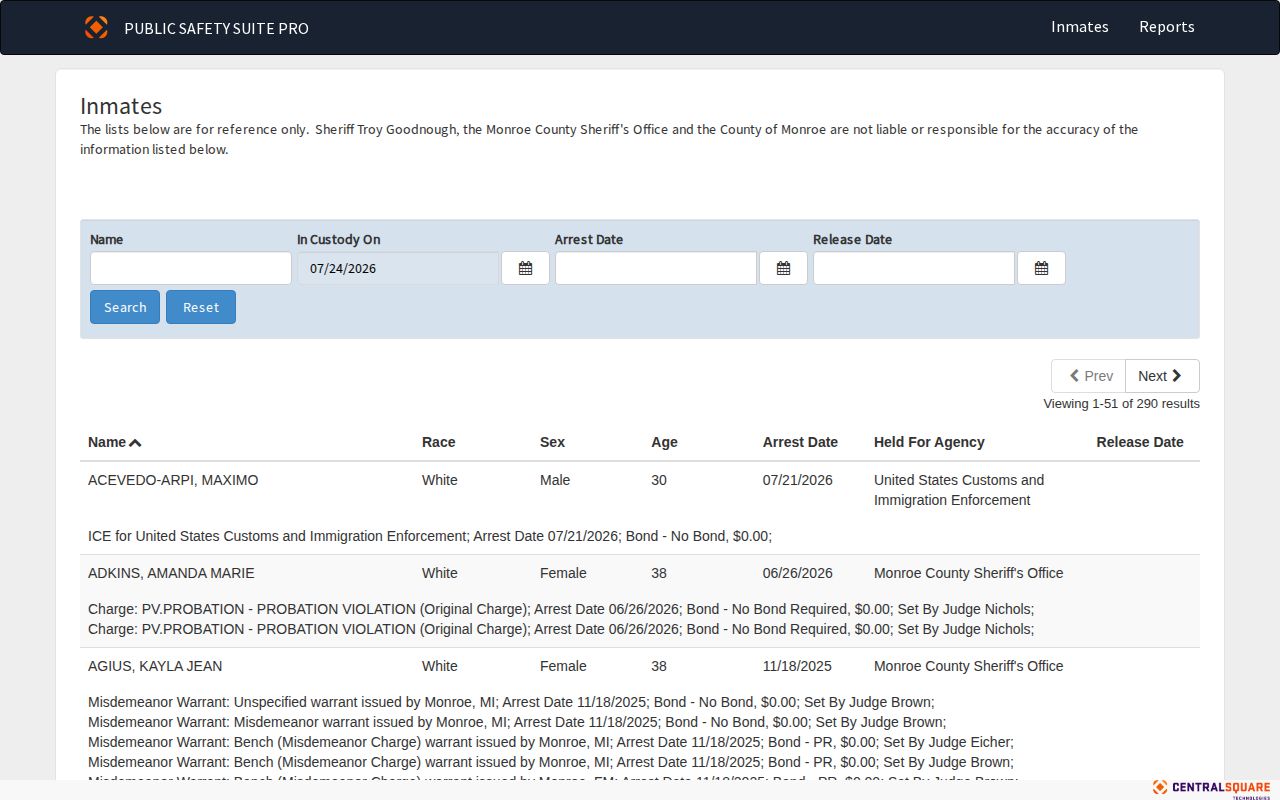
Release Date is the key field for an ended Main Jail booking, while In Custody On serves a different question about who remained held on a chosen date.
Important: Leaving the current roster is not proof of release. Look for a positive release date and then check the destination or held-for agency.
Read Monroe Jail Release Records
A useful Monroe County Jail release record ties one person to one booking. The most reliable version includes the booked name, date of birth or age, booking number, arrest date, exact release date and time, release reason, releasing facility, and the agency that held or received the person. Bond details and property disposition may also appear. The public portal exposes only part of that inventory, so its result may establish the date without explaining every legal detail.
Court records explain why custody could end. Monroe's 1st District Court handles misdemeanors and early felony proceedings, while 38th Circuit Court handles felony dispositions and sentences after bind-over. A bond entry does not prove that the bond was accepted. A dismissal of one charge does not cancel a different hold. A sentence of time served strongly supports release, yet another case may still block a return to the community. Match court events to the Sheriff's release event instead of treating either source as complete by itself.
- Release
- The end of a specific booking or custody event.
- Transfer
- A move to another custodian, not necessarily freedom from custody.
- Held-for agency
- The authority whose case, warrant, or detention request may control the next destination.
- Discharge
- In MDOC usage, the end of the state corrections relationship for the displayed matter.
Note: A populated Monroe release date is strong proof that the county booking closed, but destination details may require a complete Sheriff record.
Request Monroe Main Jail Records
The Monroe County Sheriff's Records Division is the formal county source when the portal is silent, too brief, or unsuitable for a documented need. Ask for an existing record, not a newly created certificate. A narrow request should identify the full name, date of birth or booking number if known, and the approximate booking date. Then list the existing fields sought, such as booking and release time, reason, held-for agency, receiving agency, and intake photograph.
Michigan's Freedom of Information Act, MCL 15.231 through 15.246, governs the request. The county can grant, deny, partially grant, report that no responsive record exists, or take one extension allowed by law. Fees may reflect permitted search, review, separation, copying, media, and postage costs. The county's separate card convenience charge is not the price of a release record. Inviting redaction can help the office produce nonexempt release fields even when another part is withheld.
Monroe County Sheriff Records Division
100 E. Second Street
Monroe, MI 48161
734-240-7415
Fax: 734-240-7482
Open 24 hours a day, seven days a week
sheriffrecordsmail@monroemi.org
FOIA: foia_sheriff@monroemi.org
The county FOIA request form can be used for the booking and release record. Keep proof of delivery. A response deadline does not always mean immediate production if a lawful deposit, search, or clarification is required.
Monroe Jail Federal Release Holds
Both adult Monroe County corrections facilities house some detainees for ICE and the U.S. Marshals Service. The portal's held-for list also includes U.S. Border Patrol. This local arrangement makes the release-versus-transfer distinction especially important. A release date can close the Sheriff's booking while federal authority continues. Names, language, or birthplace never establish immigration status. Only the record and responsible agency can show the custody path.
When ICE appears, use the ICE Online Detainee Locator for current searchable immigration detention. Its no-result is not proof of community release because some people fall outside its public coverage or have not yet appeared. When USMS appears, use the federal court docket and the known holding facility; the Marshals Service has no public historical locator like BOP. A sentenced federal prisoner belongs in the BOP locator, but an ordinary Main Jail release does not.
The Inmate Guidebook adds a Monroe-specific sign of continued federal control. Unclaimed ICE detainee property goes to ICE, and the Sheriff's Office will not accept or release that property without Detroit Field Office approval. That procedure would make little sense if every county release date meant a direct return home.
Monroe Main Jail Release History
Monroe County describes six generations of jail facilities. The current Main Jail opened in 1981 after a project costing more than $11 million. It was designed for 127 people, then double-bunked to a rated capacity of 183. Those figures describe the building, not the number of people released. The Sheriff's 2025 annual report separately counts 4,360 people processed across corrections, a measure of intake work rather than unique people or community exits.
The Sheriff's jail history also describes an enclosed courthouse catwalk. A detained person can cross from the Main Jail to court without leaving custody. Court movement therefore must not be read as release. The same principle applies to a move from the Main Jail to the East Dunbar dormitory: it is an internal placement in the Sheriff system, and both facilities use the same public portal and Records Division.
Note: The annual processed count measures corrections intake activity and must not be described as a count of unique releases.
Property After Monroe Jail Release
Monroe's Inmate Guidebook says personal property normally remains secured until release. Before then, a person who needs an item such as keys released to someone else must submit a written kite, name the approved pickup person, obtain supervisor approval, and complete a signed property-release form. The person collecting the item must show photo identification. This is a separate property event and does not alter the custody record.
Property rules also track the destination. A person transferred to MDOC identifies someone to collect remaining property. The Guidebook gives that collector 45 days before the property may be disposed. Released mail is not held or forwarded. Those loose ends can remain after the booking closes, so direct property questions to the facility and use the release record, not a pickup event, to establish when custody ended.