
Monroe County Supervision Compared
Parole and probation both allow a person to live outside a jail or prison while following enforceable conditions, but they begin in different ways. The Michigan Parole Board decides whether an eligible MDOC prisoner may leave prison on parole. A judge imposes probation as part of a sentence. Monroe County jail time can precede probation, yet probation can also be ordered without confinement.
The source record matters. OTIS covers people under Michigan Department of Corrections jurisdiction, including state parole and MDOC-supervised felony probation. A Monroe District Court probation order may instead be confirmed in the sentencing court record. Neither an office assignment nor an online status gives a private home address.
| Point | Parole | Probation |
|---|---|---|
| How it starts | Board-authorized release from state prison | Court sentence in the community, sometimes after jail |
| Main public trail | OTIS status, sentence, and parole date | OTIS for MDOC felony supervision or the sentencing court |
| Who supervises | MDOC Field Operations Administration | MDOC or the court probation unit, based on the order |
| How it ends | Discharge or sentence end, not mere prison release | Court or MDOC discharge after the ordered term |
These terms should not be blended. “Parole” proves physical release from prison into continued state control. “Probation” proves a community sentence, not that the person first served a prison term.
Verify Monroe County Post-Release Supervision
A name match is only a lead. Use the MDOC number when it is known. Otherwise, compare the legal name, aliases, age, physical details, sentence, and case information before treating an OTIS profile as the right person. The Monroe jail portal answers a booking question, not the full supervision question.
- Search the MDOC Offender Tracking Information System by MDOC number or name.
- Read the current status first. “Parole” and “Probation” are active community-supervision statuses, while “Prisoner” means state incarceration.
- Open the sentence details and compare offense, court, dates, aliases, and descriptors with the known Monroe County case.
- Use the MDOC probation and parole directory to identify the proper field office.
- For court probation, check the sentencing entry and register of actions in the Monroe court that issued the order.
- Ask the assigned office or court to resolve a status conflict. Do not infer discharge from silence or a roster no-result.
The manifest image below comes from the official OTIS name and number search.
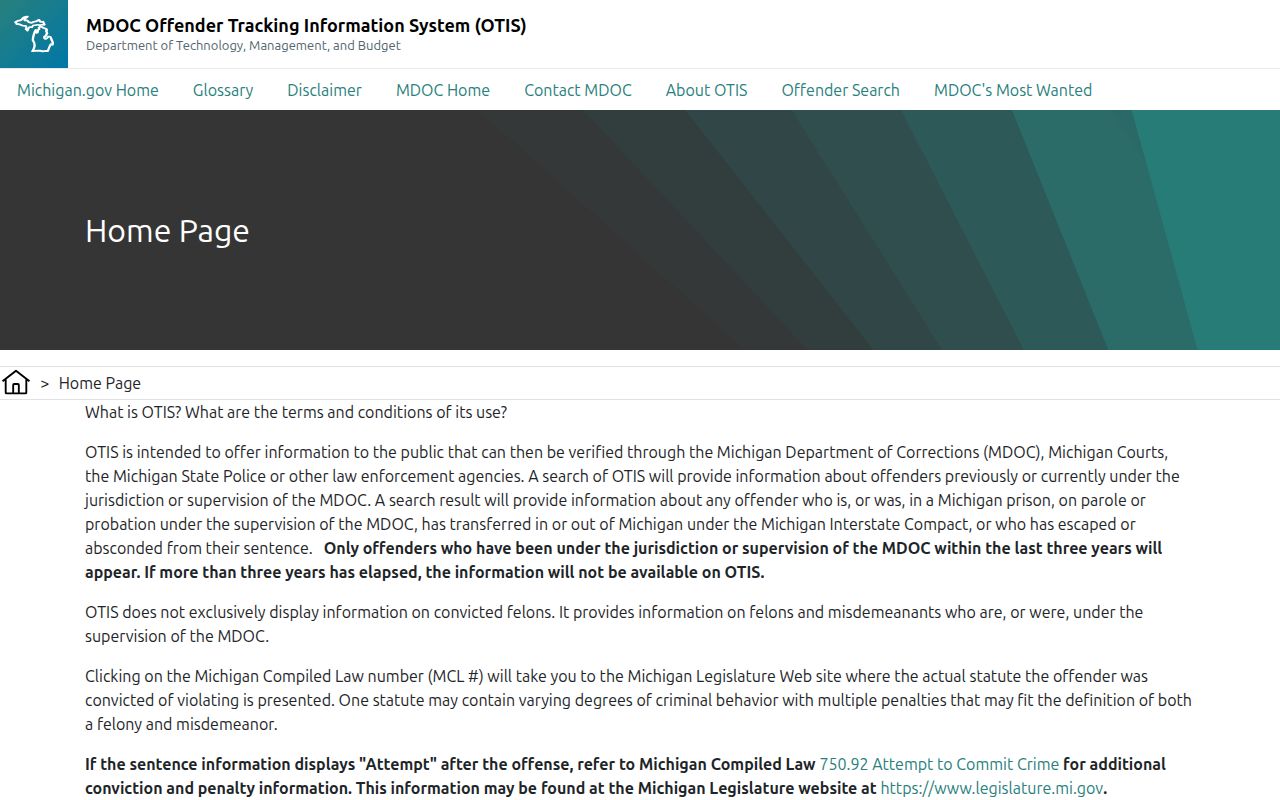
That screen is the correct state starting point for a parolee or MDOC probationer, but the resulting profile and sentence details supply the proof.
Monroe County Supervision Office
The local state contact is the MDOC Region 9 Monroe County Parole/Probation office. Use OTIS first so the inquiry has a full name, MDOC number, current displayed status, and the disputed detail. Office staff can address supervision and absconder information tied to their records. They should not be asked to interpret an unrelated county booking.
MDOC Region 9 Monroe County Parole/Probation
29 Washington Street
Monroe, MI
734-240-7640
For probation imposed by the 1st District Court or 38th Circuit Court, the sentencing court remains essential. Its judgment and register of actions establish whether probation was ordered, modified, violated, or ended. OTIS is strongest when MDOC has jurisdiction, while a court record is strongest for the terms of the judicial order.
Note: An office listing identifies the government unit handling supervision; it must not be treated as the supervised person’s residence.
Monroe County Parole Decision Trail
The Michigan Parole Board is the sole paroling authority for MDOC felony prisoners. Eligibility does not compel release. The Board weighs the offense, record, institutional conduct, programming, age, risk information, interview, guidelines, and submitted material. A grant or positive action may still precede the physical exit while placement and conditions are arranged.
Public hearing notices do not form a complete named-person parole calendar. Michigan posts event-driven notices, often for statutory lifer or clemency matters. An ordinary review can occur without appearing there. No official public search for every named person’s Board decision was verified. Individual action is documented in a Notice of Action or Decision, while quarterly reports show aggregate counts only.
OTIS may later show “Date Paroled” and a Parole status. When a decision document is needed, an entitled party may use the Board contact route or the MDOC FOIA process for an existing record. A future eligibility date or favorable Board step is not the same as the actual prison release event.
Michigan law also draws a firm line between parole eligibility and the sentence minimum. For covered modern crimes, the full minimum imposed by the judge must be served before Board jurisdiction. It is not an 85% calculation. MCL 791.234 controls key jurisdiction rules, while MCL 800.33 and 800.34 distinguish older credit systems from modern disciplinary-time sentences. Offense date and the actual judgment must be checked before a timeline is described.
Monroe County Absconder Status
An absconder is a person whom the supervising authority alleges has stopped reporting or otherwise become unavailable to supervision. The label is not a discharge. A warrant or violation entry also does not show that the supervision term has lawfully ended. Read the live OTIS status, then confirm the source entry with Region 9 or the court.
Conditions can include reporting, approved residence or movement rules, treatment, testing, financial obligations, and compliance with court or Board orders. The exact conditions belong to the individual order. A violation may lead to investigation, a hearing, changed terms, custody, or revocation, depending on the authority and facts. Do not approach a person based on an absconder or warrant indicator.
- Parole
- Conditional release from state prison while MDOC authority continues.
- Probation
- A court-ordered community sentence, sometimes following county jail time.
- Absconder
- A person alleged to be unavailable to the supervising agency.
- Revocation
- A formal action ending community release and potentially returning a person to custody.
- Discharge
- The end of the corrections or supervision relationship for the displayed matter.
Monroe County Community Corrections
Monroe County Community Corrections uses Michigan Public Act 511 support for local sanctions and programs. Its work includes jail-based and community-based options. The office is a local navigation point, but participation in a program is not proof of parole, probation, or release.
Monroe County Community Corrections
125 E. Second Street
Monroe, MI
734-240-7110 or 734-240-7115
A person may interact with Community Corrections without matching the legal status someone expects. Verify the actual order through OTIS or the sentencing court. Programs also must not be described as guaranteed benefits. Their availability, fit, and authority depend on the governing case and current program rules.
Correct Monroe County Supervision Records
OTIS corrections follow the source of the disputed fact. If the claimed error comes from the sentence, conviction, jail credit, or other court action, contact the sentencing court. If it concerns supervision status, office assignment, or an absconder entry, contact the parole or probation office. Sending the issue to the office that created the fact prevents a loop between agencies.
Released mail is not held or forwarded by the Monroe jail. A released tablet user seeking a remaining balance must contact ICS Customer Care through GettingOut or 866-516-0115. That account issue is separate from an OTIS correction and does not establish supervision status.
Keep a copy of the disputed screen, note the date viewed, and give the agency a case or MDOC number when possible. The broader Monroe County released-inmate search and records path can confirm the county custody event before a supervision question is escalated.
Monroe County Supervision Discharge
Supervision ends through a lawful discharge or sentence-end action, not because a person stops appearing on the jail roster. On OTIS, “Discharged” indicates that MDOC jurisdiction ended for the displayed matter. MDOC notes that this label can cover completion, maximum discharge, or death, so it must be read with dates and case context rather than translated into a single physical event.
Public OTIS display has a limit. Discharged offenders remain visible for three years after discharge, then may drop from the public system. An older no-result therefore does not disprove prior supervision. A focused MDOC FOIA request can seek older existing records. Court probation discharge should be confirmed in the court file or with the probation unit.
MI-VINE is useful for custody alerts, but it is not a long-term supervision archive. The final reliable chain is OTIS or the court record, the proper Monroe office, and an agency record when the public interface does not settle the question.
A Monroe County release date can also describe a transfer rather than community supervision. If the county result identifies MDOC as the held-for agency, OTIS should show the next state stage once the transfer is processed. ICE, USMS, Border Patrol, and another county require their own custody checks. No parole or probation label should be inferred from the Sheriff booking alone.
When records conflict, keep the dates and sources separate. The Sheriff can confirm the county booking end, the court can confirm the sentence, MDOC can confirm state supervision, and the Board record can confirm its action. This source-by-source method preserves the difference between release, parole, probation, transfer, and final discharge.