
Monroe County Release Meanings
A Monroe County Jail release date closes a specific Sheriff booking. It does not, by itself, say where the person went. Bond or personal recognizance can put someone back in the community while the case stays open. Time served can end one jail term, but probation, fees, another case, or a hold may remain. A dismissal ends one charge as a basis for custody, yet a different hold can still prevent a community exit.
Other outcomes cross agency lines. A state-prison commitment means the Sheriff’s booking ended through transfer to the Michigan Department of Corrections. Parole later means a state prisoner left an institution under MDOC supervision. Discharge generally marks the end of the displayed MDOC relationship, though the status must be read with its dates. A transfer to ICE, the U.S. Marshals Service, another county, or another authorized agency is continued custody. Escape, absconding, and death must never be described as ordinary release.
- Time served
- The court-ordered custodial portion credited to a case has ended.
- Parole
- Release from state prison under continuing MDOC authority and conditions.
- Probation
- Court-ordered community supervision that may follow jail or may be imposed without jail.
- Discharge
- The end of an MDOC sentence or supervision relationship shown for the matter.
- Detainer
- A request or authority that can keep custody in place for another agency.
Monroe County Release Types
The next search depends on the release type. The Sheriff’s portal can show that a booking ended, while the legal reason and destination may require the court record or a receiving agency. Keep each system in its proper role.
| Release type | What it means | Where to verify next |
|---|---|---|
| Bond or recognizance | The person leaves pretrial jail custody; the case continues. | D01 or C38 MiCOURT case, then Sheriff record |
| Time served or sentence complete | The jail term in that matter has ended. | Court judgment, release record, other-hold check |
| Dismissal or acquittal | That case no longer supports custody. | Court disposition and Sheriff held-for field |
| State transfer | County custody ends while MDOC custody begins. | MDOC OTIS |
| Parole | Physical prison release with supervision. | OTIS and MDOC field office |
| Federal or immigration transfer | The Monroe booking ends but federal custody may continue. | BOP, federal court, USMS, or ICE route |
Note: A positive Monroe County release date proves a booking ended, not that all government custody ended.
Monroe County Release Record Fields
A complete record ties the event to one person and one booking. Monroe’s public Zuercher configuration exposes name, race, sex, age, arrest date, held-for agency, hold reasons, and release date. Sheriff Records may hold more precise booking and release details. Request the exact existing record instead of asking staff to create a new certificate or answer broad questions.
| Field | What it shows |
|---|---|
| Booked name and age or birth data | Identity clues used to avoid a name-only match |
| Booking number | The specific jail episode to which the event belongs |
| Arrest or booking date | When that custody episode began |
| Release date and time | When the booking closed; the public portal may show only the date |
| Disposition or release reason | Bond, sentence completion, transfer, or another recorded outcome |
| Held-for or receiving agency | Whether another authority may have taken custody |
| Charge and hold entries | The cases or authorities associated with the booking |
| Property or account disposition | How remaining property or funds were handled |
The jail record and court record answer different questions. A court order can explain why custody should end, but it may not show the exact time the person walked out. The Sheriff release event can show when the booking ended, but it does not prove the charge was dismissed or the sentence was complete. Compare both when the reason matters.
Request Monroe County Release Records
The Monroe County Sheriff Records Division handles requests for county-created booking and release records. It is at 100 E. Second Street, Monroe, MI 48161, and can be reached at 734-240-7415. The office reports round-the-clock operation. General records email goes to sheriffrecordsmail@monroemi.org, while completed Sheriff FOIA forms go to foia_sheriff@monroemi.org.
- Download the Monroe County FOIA request form.
- Identify the person with a full name and date of birth or booking number, plus an approximate booking date.
- Ask for the booking date and number, actual release date and time, release reason, held-for or receiving agency, charge or hold entries, and existing booking photograph if needed.
- Request electronic delivery and invite redaction of exempt material so nonexempt release fields can still be produced.
- Keep proof of submission and respond to a lawful clarification or deposit notice.
Michigan’s response structure generally calls for a grant, denial, partial grant, no-record notice, or a single extension of up to ten additional business days after the initial five-business-day period. That response deadline is not always a production date. Search, review, separation, copies, media, and postage may be charged within statutory limits. Labor generally uses the lowest-paid capable employee and 15-minute increments; labor under 15 minutes is not charged. A qualifying indigent requester may seek the statutory first-$20 reduction by affidavit.
Ask for one person and one date range. A request for every release takes more search, review, and cost than a narrow custody-event request.
Monroe County Release Record Law
Michigan’s Freedom of Information Act, MCL 15.231 through 15.246, supplies the public-record framework. MCL 15.233 addresses inspection and copy rights, MCL 15.234 controls fees, MCL 15.235 sets response timing, and MCL 15.243 lists exemptions. Investigatory, privacy, security, confidential-source, and safety concerns may support withholding or redaction. An agency should identify its legal basis and separate exempt content from releasable content where required.
FOIA creates no special public-web retention period for a Monroe County released inmate entry. The portal’s unknown display window must not be confused with destruction of the agency record. A Michigan set-aside under MCL 780.621 and following sections changes public court and criminal-history access. OTIS also removes set-aside or expunged convictions from public results. A later no-result therefore cannot erase the fact that a historical booking once occurred, but nonpublic records should not be republished from stale sources.
Juvenile matters follow separate rules. The Monroe County Youth Center is not part of the adult portal, and the adult configuration excludes juveniles. An entitled person must use the Family Division or authorized facility channel instead of drawing conclusions from an adult-search no-result.
Note: Removal from a public portal does not prove that the originating agency lawfully destroyed its underlying record.
Monroe County Jail Release Scale
The Sheriff’s 2025 annual report gives useful scale, but each number needs its exact label. Corrections processed 4,360 inmates. That is intake throughput, not a count of unique people and not a count of community releases. The Main Jail’s rated capacity was 183, and the Dormitory’s rated capacity was 180, for 363 beds across the adult system.
The same report records 1,251 bonds taken for jail release and 1,986 bail-bond conditions entered. Those figures explain why bond releases form a large, visible subset. They still exclude many other jail exits, including sentence completion, time served, dismissal, and transfer.
Monroe County Bond Release Records
A Monroe County bond release ends jail custody on that booking while the criminal case remains active. The bond entry, release event, and court docket should be read together. A court order alone does not prove that cash or a surety was accepted. Likewise, the county portal’s release date does not state that every charge ended.
The 1st District Court search covers misdemeanors and early felony stages, while the 38th Circuit Court search covers felony dispositions after bind-over. Look for bond events, later hearing dates, warrant activity, charge changes, and the judgment or sentence. If a different hold exists, the person may be moved instead of released to the community.
Does bond mean the case is over? No. Bond usually permits release while the case continues, subject to the court’s terms and future appearances.
Property After Monroe County Release
The Monroe County inmate guidebook says property normally stays secured until release. An item such as keys may be released early only through a written kite that names the collector, plus supervisor approval, photo identification, and a signed property-release form. This process matters when someone needs an item before the booking closes.
For a transfer to MDOC, the incarcerated person identifies a collector. The property must be collected within 45 days or it may be disposed. Property steps are practical loose ends, not evidence of why the release occurred or where custody went next.
Note: Monroe County publishes no fixed release hours, exit door, waiting area, rideshare rule, or jail transportation promise.
Loose Ends After Monroe Release
Monroe County’s mail and tablet rules create tasks that can persist after a booking closes. Released mail is not held or forwarded. A former tablet user who has a remaining balance must contact ICS Customer Care through GettingOut.com or 866-516-0115 to request a refund. Neither a refund request nor missing mail confirms the legal basis for release.
Record corrections also go to the office that created the fact. Under OTIS correction guidance, an error drawn from a sentence should be raised with the sentencing court. A supervision or absconder error belongs with the parole or probation office. Sending the issue to the source gives the office a chance to compare its own record rather than infer from another system’s summary.
Find Monroe County Released Inmates
The official county route is the Sheriff-linked Zuercher portal. It differs from a current-only roster because Release Date is both a filter and a displayed column. This makes ended bookings searchable for at least some period, although Monroe County does not promise a refresh rate or archive depth.
- Open the official Monroe County inmate portal and search the full name.
- Compare age, arrest date, held-for agency, and hold reasons. A shared name is not enough.
- If no current result appears, search a known Release Date. For recent activity, query each calendar date that overlaps the desired time window.
- Record the release date and booking context. Check the held-for agency before describing the result.
- Read the D01 or C38 court case for bond, disposition, sentence, warrant, and register-of-actions events.
- Follow MDOC, ICE, USMS, Border Patrol, BOP, or another county when the result indicates a transfer.
- Ask Sheriff Records for the complete release event when the online result is missing, old, unclear, or needs formal documentation.
A released person may be absent from a current-custody view. Use Release Date and the agency-specific fallback instead of treating absence as proof.
The Monroe County 24-Hour Releases method explains how calendar-date searches approximate one day. It is not a separate Sheriff feed.
Monroe County Release Search Fields
The portal’s live setup defines what can be searched and read. Its filters are name, In Custody On, Arrest Date, and Release Date. Result columns include name, race, sex, age, arrest date, held-for agency, and release date. Hold reasons are enabled. The current Monroe setup omits a mugshot and cell block from the available columns even though the generic portal framework can support those items.
The official portal screen shows the county’s enabled search controls.
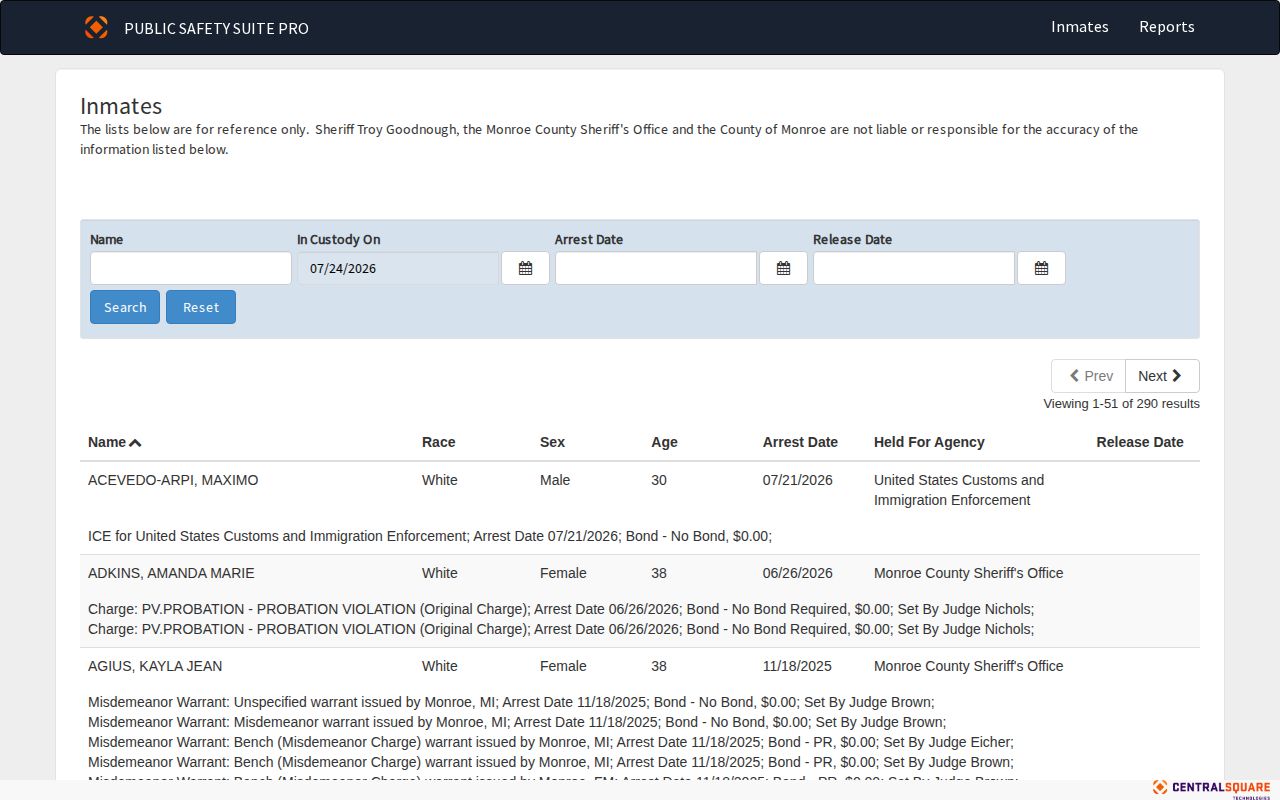
The Release Date control is the key to finding an ended county booking after the person leaves a current-custody result.
| Field | Use | Limit |
|---|---|---|
| Name | Find a candidate | Must be compared with other identifiers |
| In Custody On | Check custody on a date | Not the release-history filter |
| Arrest Date | Tie a person to a booking start | Does not say how custody ended |
| Release Date | Find bookings ending on a calendar date | Public results may not expose exact time |
| Held For Agency | Identify a possible receiving authority | Requires follow-up with that authority |
Michigan Offender Search After Release
MDOC’s Offender Tracking Information System, or OTIS, covers people under state corrections jurisdiction. It does not list every Monroe County arrest or jail-only sentence. Use the MDOC number when known. A name search can be narrowed with descriptive fields, but each candidate still needs an identifier check.
Read status before dates. Prisoner means current state incarceration. Parole means the person physically left prison under supervision. Probation means community supervision. Discharged means the displayed MDOC relationship ended, subject to the agency’s date definitions. OTIS may show sentence entries, offense data, location or supervision information, aliases, descriptors, a photo when available, and dates. A Parole Board Jurisdiction Date is an eligibility point, not proof of release. Date Paroled is the actual prison exit on parole.
The OTIS search page illustrates the state name and MDOC-number route.
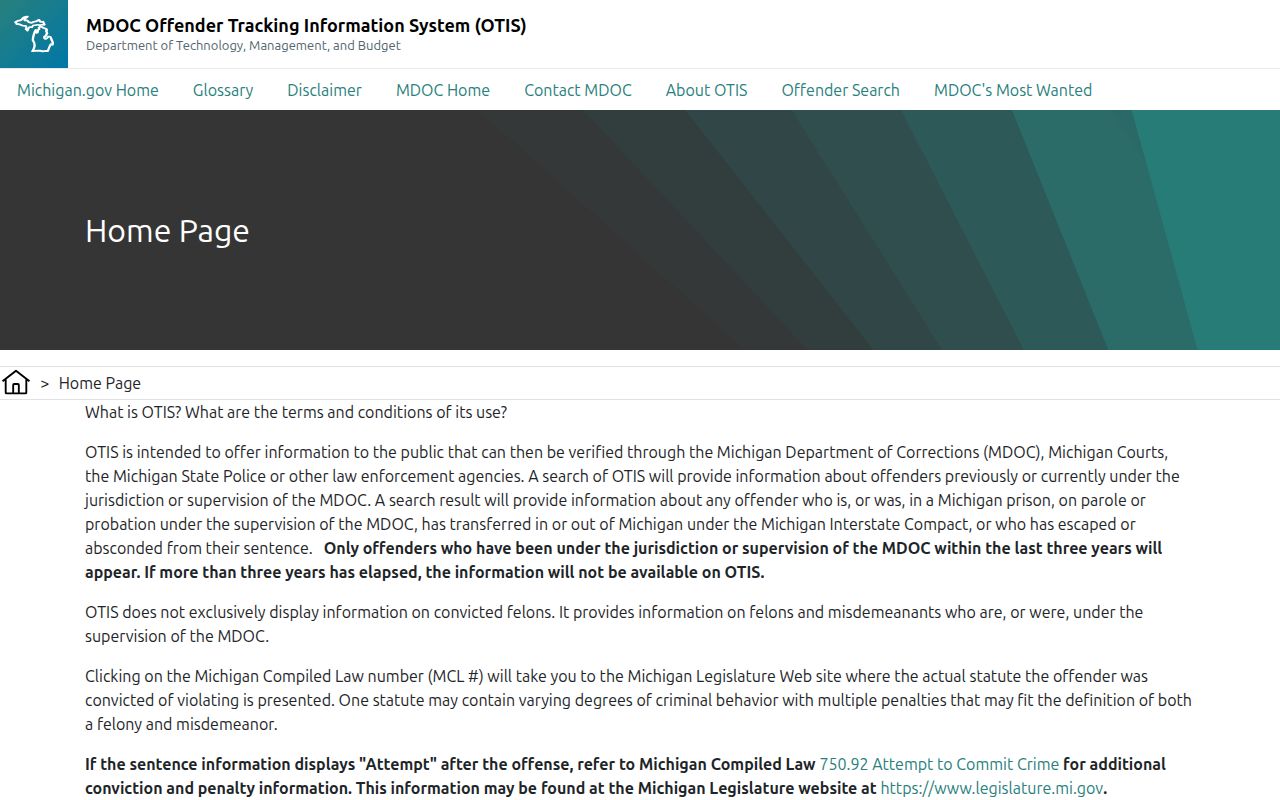
Use OTIS only when a Monroe County case entered MDOC jurisdiction or the person is on MDOC supervision.
Discharged offenders remain publicly displayed for three years after discharge under OTIS guidance. Older or more complete state records require MDOC FOIA. Removal from public OTIS, a missing image, or a no-result does not disprove an older state record.
Note: An OTIS parole-eligibility date is not proof that the Michigan Parole Board ordered or completed release.
Monroe County Court Release Checks
Monroe supplies separate court routes because different stages belong to different courts. D01 can show misdemeanor proceedings, bond, dismissal, jail credit, and early felony events. C38 is the main source for felony disposition and sentence after bind-over. Online MiCOURT information is informational and is not the official court record. Some criminal displays also have time limits.
The judiciary is outside County FOIA. When an older case does not appear online, contact the correct clerk for the register of actions, judgment, bond or release order, or certified disposition. Do not send a county executive FOIA form for a court judgment. A court no-result and a jail no-result are each inconclusive for different reasons.
The court explains legal authority. The Sheriff records the physical booking event. Comparing dates, case number, booking context, and held-for agency provides a far stronger Monroe County release finding than either screen alone.
Note: A court order may authorize release without recording the exact time the Sheriff completed the physical exit.
Monroe County Post-Release Supervision
MDOC’s Field Operations Administration supervises state parolees and many felony probationers. Search OTIS for current status, sentence, dates, and office information. The Region 9 Monroe County Parole/Probation office is at 29 Washington Street, Monroe, MI 48161, telephone 734-240-7640. District-court probation remains a court function and should be verified with the sentencing court.
An absconder or warrant indicator is not a discharge. It means an agency alleges that the person failed to report or is otherwise wanted. Verify through OTIS, the supervising office, and the case docket. Do not treat an office address as a residence. The Post-Release Supervision page gives the full Monroe verification path.
Monroe County Community Corrections
Monroe County Community Corrections uses state PA 511 support for local sanctions and programs, including jail-based and community-based options. Its office is at 125 E. Second Street and can be reached at 734-240-7110 or 734-240-7115.
This office is a local navigation point, not proof that a person is on parole, probation, or enrolled in a specific program. Verify supervision through the sentencing court, OTIS, or the assigned MDOC office. Do not promise services based only on the program summary.
Monroe County Release Alerts
The Monroe County Sheriff links directly to Michigan VINE and VINELink and publishes 800-770-7657. VINE can search a specific person in participating custody and register an offered phone, text, email, or app alert. It is most useful while the person remains in a participating jail or MDOC setting. A release or transfer alert is a cue to verify the event with the Sheriff or MDOC, not a certified historical record.
A VINE no-result is inconclusive after release because the service is not a guaranteed archive. The Michigan Public Sex Offender Registry is also not a general release list. It applies only when a person has a legal registration duty and does not supply a universal jail-release date.
The official Michigan registry search shows the limited-purpose state interface.
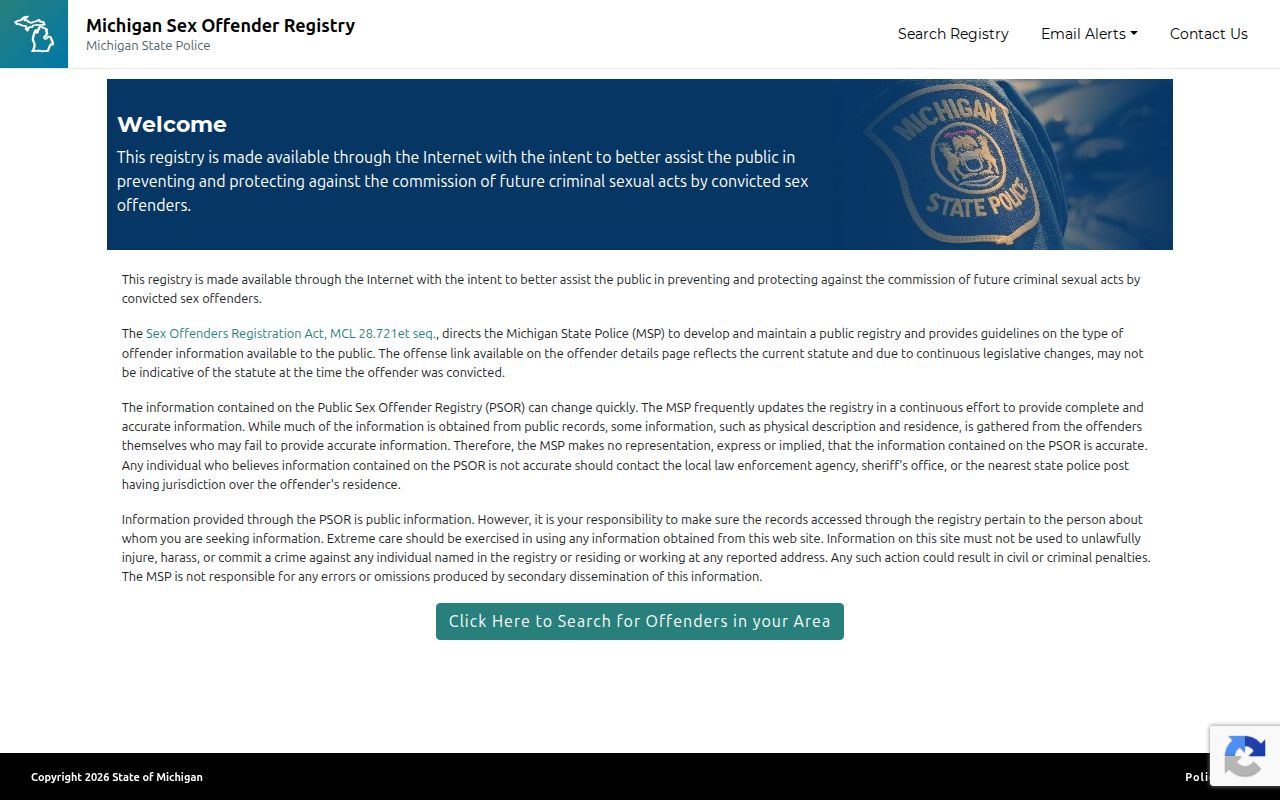
Use a registry entry only for the legal registration question it answers, then return to the custodian and court for the release event.
Monroe County Federal Custody Transfers
Both adult Monroe County facilities hold detainees for ICE and USMS. The county portal’s held-for list also includes ICE, U.S. Border Patrol, and the Marshals Service. A release date under one of these agencies can mark a handoff into continuing federal custody.
Use the BOP Inmate Locator for a person who served a federal prison sentence. A former BOP prisoner may show Released and a release date. “Not in BOP custody” is broader and may reflect release, transfer, pretrial USMS custody, or another setting. For current immigration detention, use the ICE Online Detainee Locator. Its no-result is inconclusive, especially after a recent transfer.
The USMS does not provide a public historical locator like BOP. A federal pretrial case calls for the federal court docket and custodian route. Never infer immigration status from a name, language, or birthplace.
Note: A federal locator no-result does not settle whether another federal, state, county, or immigration authority holds the person.
Monroe County Jail Release History
Monroe County describes six generations of jail facilities. The present Main Jail opened in 1981 and was later double-bunked to reach its rated capacity. The East Dunbar dormitory project began in 1999 with two 80-person dormitory units. This history explains why the Sheriff system has two adult locations but one public release search.
The Main Jail’s secure courthouse catwalk is a clear local example of movement that is not release. A person can go to court while staying in custody. A move between Main Jail and the Dormitory is also internal placement. Only a recorded booking closure, read with its destination, supports a release or transfer conclusion.
Compare Monroe County Release Sources
Choose a source based on the custody system, not just the person’s connection to Monroe County. County, state, federal, and juvenile records do not merge into one complete database.
- Current Monroe jail custody
- Start with a Zuercher name or In Custody On search; confirm through the current portal result and jail.
- Ended Monroe booking
- Start with Zuercher Release Date; confirm through the Sheriff release record and court case.
- State prison or parole
- Start with MDOC OTIS; confirm status, Date Paroled, the sentence entry, or an MDOC record.
- Federal prison release
- Start with the BOP locator; confirm the BOP status and date against the federal case.
- Possible ICE transfer
- Start with the held-for field and ICE locator; seek ICE or ERO confirmation when needed.
- Juvenile detention
- Use an authorized Family Division route; rely on the juvenile court or custodian response.
What if every public search says no result? Use the agency-specific records route. Portal retention is unknown, OTIS drops discharged people after three years, and current-event systems are not full archives.
Monroe County Release Facilities
Each facility or custody system needs its own release trail. The adult Sheriff sites share one county portal and Records Division. State and federal pages point to the agency that takes or ends custody, while juvenile access stays restricted.
- Monroe County Jail: Main Jail Facility: county release-date search, Sheriff record, court case, and held-for check.
- Monroe County Jail: Inmate Dormitory Facility: the same Sheriff portal; an internal building move is not release.
- Monroe County Youth Center: authorized juvenile-court and facility channels, not the adult portal.
- Michigan Department of Corrections institutions: OTIS and MDOC records after state commitment.
- Monroe County Jail ICE detainee housing: county booking closure plus an ICE custody check.
- Federal Bureau of Prisons facilities: BOP release history for sentenced federal prisoners.
Note: The facility that ended custody determines the first release record, even when the underlying case began in Monroe County.